Showing posts with label sports cars. Show all posts

Wednesday, 27 May 2015

BMW 3.0 CSL Hommage

BMW’s iconic 3.0 CSL has taken a 21st century-design approach and the result is a befitting tribute to the classic and a dramatic-looking concept car.
The 3.0 CSL Hommage is a recreation of the classic 3.0 CSL from the early 1070s, and the racing versions of these cars were nicknamed ‘Batmobile’ after the extreme aero packs were added.
The concept is said to be based on the M4 and comes with a 3.0-litre straight-six petrol engine with an ‘e-boost’ electric motor under the hood. The new Hommage has an aggressive front fascia with a "modern interpretation of the earlier car’s highly distinctive shark nose." The grille and the aggressive headlights give the car a wicked look. Styling cues are retained from the classic model. The car gets a carbonfiber front splitter and a prominent grille that is flanked by slender laser and LED headlights. The aerodynamic body of the concept car is as dramatic as its predecessors. There are vast flared wheel arches with sculpting to channel the air towards the rear of the car.
Moving further back, there are muscular fenders, carbonfiber side skirts and small rearview cameras acting as mirrors which enhance the car’s appearance. The concept has a roof spoiler followed by a tail spoiler, and huge side exhausts. Along with, LED taillights and 21-inch alloys, the concept also gets a CFRP diffuser.
On the inside, there are two lightweight sport seats with contrast stitching and the instrument cluster inside the cabin goes the minimalist way. It also has a unique steering wheel and alloy pedals. The 3.0 CSL lives up to its Hommage name by using lightweight material, including carbon fiber which is visible from some points and materials that the BMW uses extensively on its i and M cars.
BMW insists that the concept is a one-off creation with no production future, however the concept might hold some significance for BMW’s future production models. The 3.0 CSL Hommage is the third in the Hommage range from BMW, following on from the M1 Hommage from 2008 and the 328 Hommage which celebrated the 75th anniversary of the 328 racer in 2011.

Thursday, 4 December 2014

DC Avanti

DC Avanti is India’s first true sports car, slated to launch in early 2015 at a price of approximately ₹ 35 lakh.  The DC Avanti is a mid-engined sports car. To begin with, the Avanti is really big at a length of 4550 mm, 1965 mm wide and 1200 mm in height. To give you a fair idea of its real world dimensions: the Lamborghini Gallardo is 4,345 mm long, 1,900 mm wide, and 1,165 mm in height, in comparison.  DC has also tried to make the car as usable as possible in India, and has given it a ground clearance of 170 mm - which is the same as a Maruti Suzuki Swift's. This is to make it more suitable for Indian roads. The chassis is a box section space frame, which has been overbuilt to help handle it better on Indian roads. The body of the car uses carbonfibre in many parts, which have been crafted in-house, which is placed on top of the chassis.
 
Between the seat back and the rear wheels is the mid-mounted is a 2.0-litre four-cylinder turbocharged engine, which makes 248 bhp, and 24.6 kgm of torque. Helping put all that power to the road are 20-inch wheels with 255/35 tyres mounted on the front, and 295/30 tyres mounted on the rear. A six-speed manual gearbox comes as standard on the car. Stopping power for the car comes from 330 mm ventilated four-pot disc brakes at the front and 295 mm at the rear. Anti-lock braking system, which has been developed by Continental, comes standard on the Avanti. The suspension uses a double wishbone on all four wheels, monotube with gas-charged shock absorbers. It uses coil springs to perform the dampening duties.
 
As for the interiors, the Avanti gets a three-spoke steering wheel, hooded dials, a centre console with stacked screens, chrome surrounds and body colored separators. It also comes with a touchscreen infotainment system and soft touch buttons for the air-conditioning system. The final car is expected to come with a digital instrument panel, and few new bits on the centre console too.
 
When launched, DC Avanti will be priced at ₹ 35 lakh.

Sunday, 30 November 2014

Porsche 911 Targa to be launched early next year

The 911 Targa is one of the most recognizable body styles ever created within the 911 range. With its revolutionary styling and awe inspiring design elements, the newest generation 911 Targa, unveiled earlier this year will soon make its way to Indian shores very soon. Since its launch in 1965, the Targa has held a firmly established position within the Porsche 911 family as a worthy alternative to the cabriolet, representing about 13 percent of all 911 cars ever sold. The 911 Targa will join the coupe and the cabriolet bodystyles to extend the 911 range in the country.
Porsche 911 Targa 4S rear
The latest generation of the 911 Targa variant now combines the classic Targa concept with a highly advanced roof-activating mechanism. Just like the legendary original Targa, the new model has the characteristic wide bar instead of the B pillars, a moving roof part above the front seats and a wrap-around rear window without C pillars. Unlike in the older classic models, the roof panel is now opened and closed at the press of a button instead of being a separate piece as was always the case.
The roof system consists of two moving parts: a soft top and a glass rear window. At the press of a button, the glass rear window opens to the rear and tilts. At the same time, two flaps in the targa bar open and release the soft top. The soft top is unlatched, folds to the rear into a Z-shape during the opening movement and stows behind the rear seats. When the top is stowed, a wind deflector integrated in the cowl can be adjusted manually to prevent wind buffering inside the cabin. While the car is stationary, the roof can be opened or closed in about 19 seconds from controls on the centre console.
Porsche 911 Targa 4S side
The Porsche 911 Targa will be available only with an all-wheel-drive drivetrain in the 4S guise and will be available with standard features like Porsche Active Suspension Management and Porsche Torque Vectoring that makes it more agile than past generations. The Targa 4S will feature a 3.8-litre straight six engine giving it 400 PS of peak power propelling it from 0-100 kmph in 4.4-s.The Porsche 911 Targa 4S should be priced around the ₹ 1.75 crore mark (ex-showroom).

Thursday, 27 November 2014

BMW M3, M4 launched at ₹ 1.19 crore and ₹ 1.21 crore

Close on the heels of the M5 launch, BMW has now launched two more performance- centric models in India. The BMW M3 and M4 bear a sticker price of ₹ 1.19 crore and ₹ 1.21 crore (ex-showroom, India) respectively.
The highlight of the two new Ms is the new engine – the powerful yet efficient 3.0-litre six-cylinder twin-turbo petrol engine that develops 425 bhp and 56.1 kgm of torque. All this power is sent to the rear wheels via a seven-speed dual clutch automatic gearbox with paddle-shifters. Both cars sprint from 0-100 kph in a little over four seconds, before going on to an electronically limited top speed of 250 kph. Thanks to abundant use of light weighting materials, both cars weigh less than 1,500 kg. This not only helps performance but also fuel efficiency, which is up by a claimed 25 percent.
Both the M3 and M4 are based on the 3-series sedan and share similar design elements. Their cabins also mirror the 3-series sedan, albeit with a few tweaks. On the electronics front, they get track-inspired systems like Dynamic Stability Control (DSC), Stability Clutch Control (SCC), three driving modes (Comfort, Sport and Sport Plus) and launch control function.
Apart from the slightly different nomenclature, both cars are pretty much similar to each other. The M4 is the coupé and slightly more low-slung than the M3, which gets two extra doors given that it is a sedan.

Nissan GT-R

Nissan has launched the updated GT-R in Japan, with some mechanical and cosmetic tweaks.
On the mechanical front, the Nissan GT-R gets modified dampers and ECU to provide better stability on corners and improve steering feedback. The powertrain management systems and the flywheel housing bearings have been tweaked to reduce NVH levels. The brakes also get new parts to make them less noisy, and vibrations on idle have been reduced too.
The Nissan GT-R continues to be powered by a 3.8-litre twin-turbo V6 petrol engine that makes 538bhp and 64kgm of torque. The V6 is mated to a six-speed dual-clutch automatic gearbox with paddle shifters.
Other changes come in the form of a modified trunk carpet to improve sound deadening, and modified run-flat Dunlop tyres that, according to the brand, will improve the GT-R's ride quality, and straight line and tough road stability.
Cosmetically, the GT-R gets new headlights with four LEDs each, and optional split-spoke RAYS alloys in a blue-black chrome finish. On the inside, it gets an optional package in either red or ivory, which includes new leather upholstery, hand-stitching on the front seats, accents on the instrument panel, steering wheel, door handles, armrests and gear knob.
Alongside, Nissan has also unveiled a GT-R 45th Anniversary Edition. Made specifically for the Japanese markets, the GT-R Anniversary Edition gets a special Silica Brass paint shade, Nissan logo on the centre console, and a model plate number in the engine compartment. Production of the special edition GT-R will be limited to 45 units.

Wednesday, 26 November 2014

The Chevy Chaperral

400 km/h top speed. 0-100 km/h in 1.5 seconds. A frickin' 671kW laser. And 750kW. Welcome everyone, to the most insane Gran Turismo concept we've ever seen.
Unveiled at the Los Angeles Motor Show, this fighty little thing is called the Chaparral 2X Vision GT, built - as you're probably aware - for Kazunori Yamauchi's seminal Gran Turismo racing series.
Those with particularly long memories will remember Chaparral: the Texas-based outfit partnered with Chevy over 45 years ago, knocking out a few outlandish racers along the way.
Unlike many of the Vision GT concepts you've seen from the likes of BMW, Mitsubishi and Subaru, this one's actually real. If you pop down to the LA show now, you'll be able to touch it and everything.
We're told the 2X - in the game at least - packs a 671kW laser (cue Dr Evil close up) powered by a pack of lithium-ion batteries, and an air-powered generator to produce a cool, clean 750kW. Think McLaren P1 territory. Chevy tells us this powertrain was "inspired by technology derived from advanced work targeted at space travel and future aircraft design." This is excellent inspiration.
How does it work? The mid-mounted laser beamed energy propulsion system, we're told, pulses beams of light that focus in a shroud, to create shock waves that generate massive thrust.
In Gran Turismo, it'll do the performance stats as mentioned above. And if you actually get inside, you'll find the most bizarre - and slightly intimidating - seating position ever. You lie face down with your arms and legs splayed out towards the wheels, with suspension and propulsion built around the driver, which, says Chevy, "enables progressive strategies of active and driver adjustable aero."
"The Chaparral 2X VGT is a vision of how advanced technology may shape the look and driving experience of racing," explains Chevy. "Chaparral's race cars and methods were seen as outlandish four decades ago. The 2X VGT concept might just be a harbinger of motor sports in the next four decades."

New pic of ‘baby’ McLaren supercar

It has been exclusively revealed that McLaren's upcoming, entry-level supercar will have at least one door.
Car image
We jest, of course, because this news comes off the back of McLaren's latest teaser image for the P13 ‘baby' supercar, part of Woking's new ‘Sports Series' range. As you can see, there is a rather cool door involved.

And it's no ordinary door, but a vertically opening dihedral door. We suspect there shall be another, too.

What else do we know about the Sports Series? It'll go up against both the new Mercedes-AMG GT S and Porsche 911 Turbo, and is expected to arrive around April 2015.

It'll be based on a spin-off of the carbon fibre tubs used in the McLaren 650S and P1, with aluminium body panels and a variation of the familiar 3.8-litre twin-turbo V8 and seven-speed dual clutch ‘box.

We'll find out more as McLaren continues its #BlackSwanMoments teaser campaign for the Sports Series range so stay tuned.

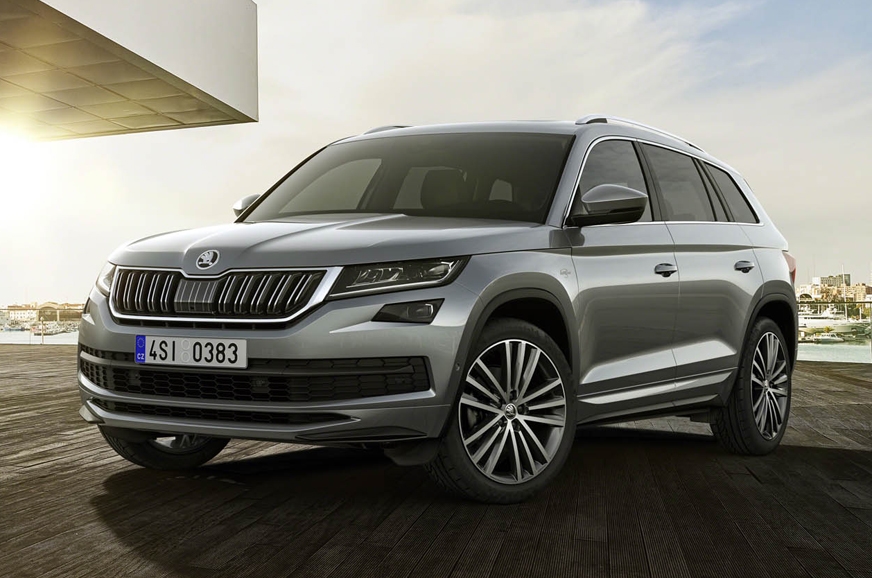
Skoda Kodiaq L&K revealed

On the exterior, the Skoda Kodiaq L&K Edition (named after the founders, Laurin and Klement) gets a new chrome-finished grille, LED he...