Thursday, 28 May 2015

Brabus B50 hybrid

Brabus - the tuner of 700 bhp G63 6x6 fame - appears to have gone soft. After years of extracting loony power outputs from V8 and V12 AMGs, it's decided to turn its attention to hybrids.Those with a penchant for 800bhp E-Classes can relax, though; everyone's favourite Merc modifier has turned its attention to just one hybrid, and it's done so in the only way it knows how: more power.
Meet the B50 Hybrid, a Brabus version of the Mercedes S500 Plug-in Hybrid.
Its 3-litre V6 turbo engine has gained 51bhp and , while its electric motor has remained untouched. These, then, are modest gains in the world of Brabus, but still enough to make this a 493bhp, car with the ability to charge up from the mains and stroll silently through cities.


At 4.9secs, the 0-100 kmph sprint has dipped 0.3secs, though the top speed remains electronically pegged at 250 kmph thanks to the intricacies of that petrol-electric setup.

The result, is an "even more superior driving sensation" than the standard S500 hybrid, which ought to please chauffeurs the world over. Quite how the Merc's claimed 100mpg and 65g/km are affected has not been revealed, but away from the combined cycle dreamworld, we'd expect real world economy to fall as subtly as those power figures have climbed.

On top of mechanical tweaks, the B50 also hosts a variety of familiar Brabus styling flourishes: you can cram alloys of up to 22 inches into the arches, while assorted aerodynamic addenda has been honed in actual wind tunnels.

Maruti Celerio diesel launch on 3 June

The Maruti Celerio diesel is set to launch on June 3, 2015. The car badged Maruti Celerio DDiS 125 will be powered by Maruti’s indigenously developed 793cc two-cylinder diesel engine developing 47 bhp at 3,500 rpm and 12.7 kgm of torque at 2,000 rpm.
This engine will be Maruti’s first in-house developed motor to ever go on sale. The 793cc engine will also make the Celerio diesel the most efficient car in India with an ARAI fuel efficiency of 27.62kpl.
The Celerio diesel will be available in the standard three trim levels – LDi, VDi and ZDi – and will be equipped with a five-speed manual transmission as standard. The interiors will remain unchanged with the diesel variants sharing the same features as its petrol sibling. The VDi trim may get the addition of ABS which is absent in the Celerio VXi.
The Celerio diesel will be priced competitively and will rival the likes of the Chevrolet Beat diesel and Hyundai Grand i10 diesel.

Lamborghini Urus to go on sale in 2018

Lamborghini has finally announced that its Urus concept-based SUV will go on sale in 2018. The premium SUV will be made at the company’s factory in Sant’Agata Bolognese and will be the third production model to be made after the Aventador and Huracan.
This SUV is expected to draw a lot of inspiration from the Urus concept first shown at the Beijing Motor Show in 2012. The radically styled concept displayed extensive use of carbon fibre and a turbocharged 5.2-litre V10 motor with a transmission-mounted electric motor. Details are still scarce but expect it to be one of the most powerful SUVs ever made.
Lamborghini president and CEO Stephan Winkelmann said, “This is a proud moment for everybody in Lamborghini. The introduction of a third model line endorses the stable and sustainable growth of the company and signifies the beginning of a new era.”
Lamborghini will also expand its Sant’Agata Bolognese plant and is looking to invest “hundreds of millions of Euros” in the facility. This investment will increase the size of the plant from the current 80,000 square metres to around 150,000 square metres and the company intends to hire 500 new employees.
The Italian carmaker plans to spread its sales across the globe, and has identified the USA, China, the Middle East, United Kingdom, Germany and Russia as its main target markets. With a target of
3,000 units a year in mind, Lamborghini wants to double their current sales figures.

Honda Jazz launch on 8 July

Honda will launch the new Jazz on 8 July. The carmaker previously released teasers of the hatchback on its social media arms and official website. The new Honda Jazz was supposed to hit Indian showrooms in March 2015, but was delayed citing production issues.
 
The new Honda Jazz will come in two engine options — a 1.2-litre petrol and a 1.5-litre diesel. The petrol version will also get a CVT automatic option. When launched, the new Jazz will compete with the likes of the Maruti Swift, Hyundai i20, Volkswagen Polo,Fiat Punto Evo and the Tata Bolt.
 
You can expect the new Jazz to be feature-rich, with kit a Bluetooth-equipped touchscreen infotainment system and alloy wheels.
 
Known for its brilliant packaging and massive cabin space, the Jazz is a global bestseller for Honda. And because it is assembled here this time around, with engines manufactured here as well, Honda will be able to price the Jazz competitively.

Wednesday, 27 May 2015

Mahindra Quanto facelift SPIED

Mahindra is working on an updated version of its compact SUV Quanto and says it is planning to launch it this year. In fact, Mahindra will also reposition the car as an SUV this time around.The earlier version of the Quanto looked more like a multi-purpose vehicle as it shared its looks with the Mahindra Xylo.  The Quanto was unable to sell as per the automaker’s expectations. In 2014-15 (Apr-Mar), the Quanto sold over 1,900 units as against the EcoSport which sold over 52,000 units.
However, Mahindra is all set to breathe some life into the Quanto and provide it a new identity by giving a distinctive bonnet with a scoop. Other bits in the updated exterior include redesigned headlamps, grille and bumper.Pravin Shah, President and CEO of Mahindra’s automotive division said that he was working on the Quanto and added that the company would roll out the update this year.
Apart from the refreshed exterior, the updated Quanto will also get alloy wheels for the higher variants. and a new beige-themed dashboard and steering wheel amongst other amenities.The Quanto will come with the existing 1.5-litre three-cylinder diesel motor, good for 98.6 bhp and 24.4 kgm of torque. It will be mated to a five-speed manual gearbox.


Moreover, the automaker is also working towards launching two new compact SUV’s such as the Mahindra S101 (internal codename), an all-new compact SUV developed ground-up as a sub-four-metre vehicle on monocoque architecture and the Mahindra U-301 that has been built on the next-gen ladder chassis which was first seen on the new Scorpio.

Tata Safari Storme facelift priced at ₹ 10.41 lakh

Although there has been no official launch yet, deliveries for the Tata Safari Storme facelift have already started. Dealers have been taking bookings for some time already for an amount ranging from ₹ 10,000- 50,000. The facelifted car has been priced in the same range as the predecessor – starting at ₹ 10.41 lakh.
The mildly updated Storme gets some styling tweaks inside and out and some additional equipment. On the outside, there’s a new Land Rover-like grille while inside, there’s a new steering wheel (similar to the one on the Zest and Bolt), and an all-black theme with silver accents.
Added features include rear parking sensors, centre armrest for rear passengers and a new audio system with a display screen, USB, aux-in and Bluetooth compatibility, and steering-mounted controls.
Mechanically, the updated Safari Storme gets the Aria’s 2.2-litre Varicor diesel engine that makes 148 bhp and 32.63 kgm of torque – an extra 10 bhp over the previous model.

Prices (ex-showroom, Delhi)--

LX - ₹ 10.41 lakh
EX - ₹ 11.61 lakh
VX - ₹ 13.02 lakh (4x4 - ₹ 14.34 lakh)

BMW 3.0 CSL Hommage

BMW’s iconic 3.0 CSL has taken a 21st century-design approach and the result is a befitting tribute to the classic and a dramatic-looking concept car.
The 3.0 CSL Hommage is a recreation of the classic 3.0 CSL from the early 1070s, and the racing versions of these cars were nicknamed ‘Batmobile’ after the extreme aero packs were added.
The concept is said to be based on the M4 and comes with a 3.0-litre straight-six petrol engine with an ‘e-boost’ electric motor under the hood. The new Hommage has an aggressive front fascia with a "modern interpretation of the earlier car’s highly distinctive shark nose." The grille and the aggressive headlights give the car a wicked look. Styling cues are retained from the classic model. The car gets a carbonfiber front splitter and a prominent grille that is flanked by slender laser and LED headlights. The aerodynamic body of the concept car is as dramatic as its predecessors. There are vast flared wheel arches with sculpting to channel the air towards the rear of the car.
Moving further back, there are muscular fenders, carbonfiber side skirts and small rearview cameras acting as mirrors which enhance the car’s appearance. The concept has a roof spoiler followed by a tail spoiler, and huge side exhausts. Along with, LED taillights and 21-inch alloys, the concept also gets a CFRP diffuser.
On the inside, there are two lightweight sport seats with contrast stitching and the instrument cluster inside the cabin goes the minimalist way. It also has a unique steering wheel and alloy pedals. The 3.0 CSL lives up to its Hommage name by using lightweight material, including carbon fiber which is visible from some points and materials that the BMW uses extensively on its i and M cars.
BMW insists that the concept is a one-off creation with no production future, however the concept might hold some significance for BMW’s future production models. The 3.0 CSL Hommage is the third in the Hommage range from BMW, following on from the M1 Hommage from 2008 and the 328 Hommage which celebrated the 75th anniversary of the 328 racer in 2011.

Tuesday, 26 May 2015

Ford Figo ASPIRE

Ford India has begun to display its sub-four metre compact segment challenger, the Figo Aspire, at malls across India. The car is all new and boasts some segment firsts that make it quite the contender in this pocket of the market. Here is all you need to know about the new Ford Figo Aspire –


Ford says that the subcompact segment is burgeoning, given the tax benefits and the changing needs of a family. It has studied the market as well as the needs of its potential customers and has designed the Figo Aspire accordingly. Ford is banking on the uniqueness of the Figo Aspire to enter the market as well as take the fight to the segment leader, the Maruti Suzuki Swift Dzire.
Ford says that the Figo Aspire was always conceptualised as a four-metre sedan and hence has a proportionate design. The boot does not look like an afterthought and the Figo Aspire is indeed a very neat looking sub-four metre car. The front grille bears resemblance to the new Fiesta’s grille design. The windows are large and should make for an airy feeling cabin. The tail lamps are of the wrap-around kind. A single chunky chrome strip runs across the bootlid with the Ford logo at its centre.
The interiors look good and the quality has improved considerably over the current Figo hatchback. Beige is the most prominent colour inside and is used liberally across the cabin. The lower half of the dashboard, door trims and the seats are all dipped in beige. The centre console is similar to that on the Ford EcoSport and has a flat shelf with an anti-slip mat over it. It is large enough to accommodate a phone with a 5.5-inch screen. There are 23 storage spaces inside the cabin including bottle holders of varying depths. A USB, Aux and 12V charging ports are located just ahead of the gear stick. The top end variant comes with automatic climate control and Ford says the air-conditioning system is better than that on the current Figo hatchback. This is notable considering the fact that the Figo hatchback’s air-conditioning system is the best in class
The Ford Figo Aspire comes with a new instrument cluster with a multi-information display (MID) that has readouts for odometer, trip meter, average speed, average fuel consumption, instantaneous fuel consumption, distance to empty (DTE) and door ajar warning. The Figo Aspire will also come with a MyFord Dock feature. It’s a docking station for your phone or MP3 player and once connected, enables you to play music via the car’s entertainment system. The docking station also charges your phone and MP3 player. The MyFord Dock feature, however, will not be available in the top end variant since it comes with an integrated music system with the Ford Sync technology.
There will be three engine options – a 1.2-litre Ti-VCT petrol, 1.5-litre Ti-VCT petrol and the 1.5-litre TDCi diesel. Ford says that the new 1.2-litre Ti-VCT petrol delivers improved fuel economy. The 1.5-litre diesel is similar to the unit in the EcoSport, however, with an optimised state of tune in the Figo Aspire. Though Ford has not released power or torque figures, it says that the numbers will surprise the competition. The 1.5-litre petrol engine will get the dual clutch automatic transmission because Ford does not have an auto transmission that’s mated to an engine with a lower displacement. The company highlighted the point by saying that even its 1-litre EcoBoost petrol does not come with an auto transmission. The 1.5-litre petrol engine with the autobox is used worldwide and the company did not want to take chances with reliability. Except for the dual clutch automatic transmission, all the powertrain components are localised.
Ford-Aspire-Gearlever         The Figo Aspire also comes with six airbags, a first in the segment. In addition, the car gets ABS with EBD, ESP and Hill Launch Assist


Ford says that the Figo Aspire carries the ride and handling DNA that has been the hallmark of the company’s cars. The car will be fun to drive and Ford believes this will be one of the Figo Aspire’s standout features. The electronic power assisted steering (EPAS) is the same as that in the Fiesta but with revised calibration to suit the Figo Aspire. The Fiesta is known to have one of the most communicative electrically assisted steering systems.
The Ford Figo Aspire will be easy on the wallet when it comes to maintenance, says Ford. The service interval will be either one year or 10,000km, whichever comes earlier. Spares are reasonably priced and as per market standards as well as customer expectations. Regular service for the Figo Aspire would cost ₹ 2,199.
Ford’s Child Parts Concept has been utilised for the new car too. The concept, essentially, breaks down the whole unit into sub-parts. So, for example, the outside rear view mirror (ORVM) consists of a casing, an outer cover for the casing and a mirror. In the event that the ORVM grazes past something, the customer will only have to replace the damaged part and not the entire unit. The concept is applicable to the mechanical bits too and Ford says that this reduces the cost of ownership of the vehicle.
Ford has not revealed the prices for the Aspire but says that the price range will shake up the segment (their words, not ours). We expect Ford to launch the Figo Aspire by July-August, 2015.

Porsche granted GT5 trademark

Porsche has trademarked the GT5, pointing towards a new motorsport-developed version of its cars. Porsche’s high-performance models have always carried numbers in relation with the FIA class they are designed to race in. For example, the Porsche 911 GT3 was designed for use in the FIA Group GT3 class.
Since there is no motorsport called GT5, this new trademark indicates that it will be a model never seen before and will  stand out in the motorsport environment. The new car may take the form of a flagship version of the Panamera or Macan. A spokesperson from Porsche said, “There’s no comment on that (GT5) in relation to what our future product might be.”
The flagship versions of Porsche cars are developed by Porsche’s Weissach-based GT division, which applies motorsport logic and expertise to develop more capable cars. Andreas Preuninger, head of the GT division, had previously indicated that he thought there was more room in the company’s line-up for more focussed models.
The production of GT models is usually limited but since the interest in the line is clearly growing, widening the range would be a great idea for Porsche.

BMW 6-series facelift India launch

BMW is set to launch the facelifted 6-series in India on May 29, 2015. The car gets minor styling changes but retains the 3.0-litre straight-six diesel engine from its predecessor.
The exterior changes to the facelifted car are minor – restyled front and rear bumpers, a new-look kidney grille, redesigned alloy wheels and new LED headlamps. There are also four new exterior colour options.

On the inside, the facelifted 6-series gets new two-tone leather upholstery and a heads-up display, the rest of the cabin carrying on unchanged. BMW claims interior quality has been improved and is more upmarket now.
Under the hood, the new BMW 6-series continues to sport the 3.0-litre straight-six diesel engine developing 309 bhp and 64.2 kgm of torque from the older car. It sends power to the rear wheels via an eight-speed automatic gearbox.
The BMW 6-series facelift will be imported into India in the form of CBUs and will rival the likes of Mercedes' CLS class.

Mahindra XUV 500 facelift launched

Mahindra has launched the XUV500 facelift at ₹ 11.21 lakh (ex-showroom, Delhi) with some discernible cosmetic tweaks on the outside and new features on the inside.
Changes to the exterior include a new front grille with chrome inserts, new projector headlamps with LED light guides and a new design for the bonnet. The front bumper is also new as are the fog lamp housings.
Mahindra XUV500 facelift launched at Rs 11.21 lakh
The Mahindra XUV 500 facelift also gets new alloy wheels and ORVM puddle lamps.
Moreover, the window lining has been given a chrome treatment which gives the car a premium look.
Other changes on the outside include new door handles and a larger rear registration plate enclosure with a chrome appliqué above.
On the inside, the Mahindra XUV500 facelift gets a new black and beige theme coupled with blue lighting. Other features on offer (as per trim levels) include a six-way power adjustable driver’s seat, a rear-view camera, beige leather seats, new aluminium pedals, keyless entry with push button start and a bigger touchscreen for the infotainment system which also gets GPS navigation.
The Mahindra XUV500 facelift retains the same engine as the outgoing model – 2.2-litre four-cylinder diesel motor good for 138 bhp and mated to a six-speed manual gearbox. It does get a new ESP stability control system known as ESP 9.
Mahindra says fuel efficiency of the XUV500 facelift has been improved and claims that the car will now return 16 kpl as against 15.1 kpl earlier.
The carmaker has also introduced a new top-end W10 trim of the XUV500 priced at ₹ 14.99 lakh for the 2WD version and ₹ 15.99 lakh for the top 4WD version.

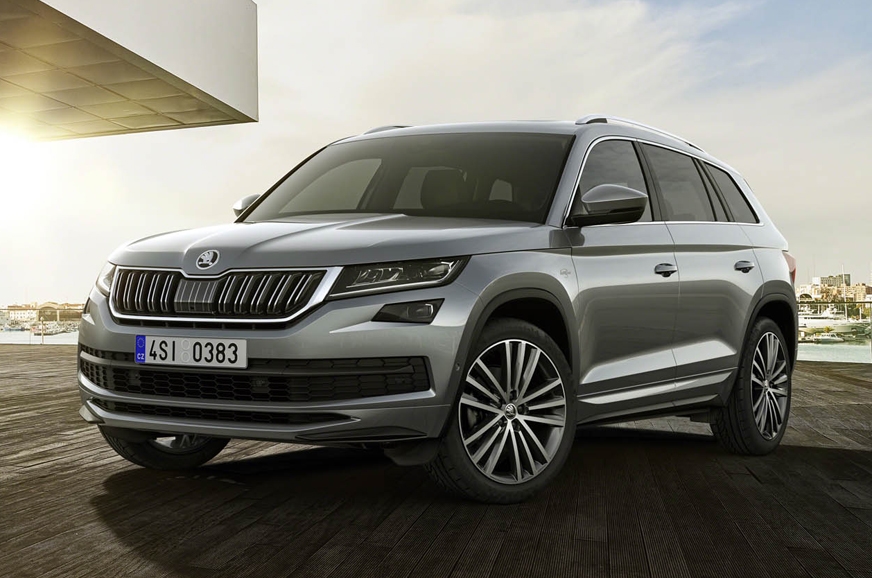
Skoda Kodiaq L&K revealed

On the exterior, the Skoda Kodiaq L&K Edition (named after the founders, Laurin and Klement) gets a new chrome-finished grille, LED he...